Follow this link to skip to the main content NASA Jet Propulsion Laboratory California Institute of Technology JPL HOME EARTH SOLAR SYSTEM STARS & GALAXIES SCIENCE & TECHNOLOGY BRING THE UNIVERSE TO YOU JPL Email News RSS Mobile Video
JPL Banner
Mars Science Laboratory
Home
MISSION
Overview


Curiosity: The Next Mars Rover
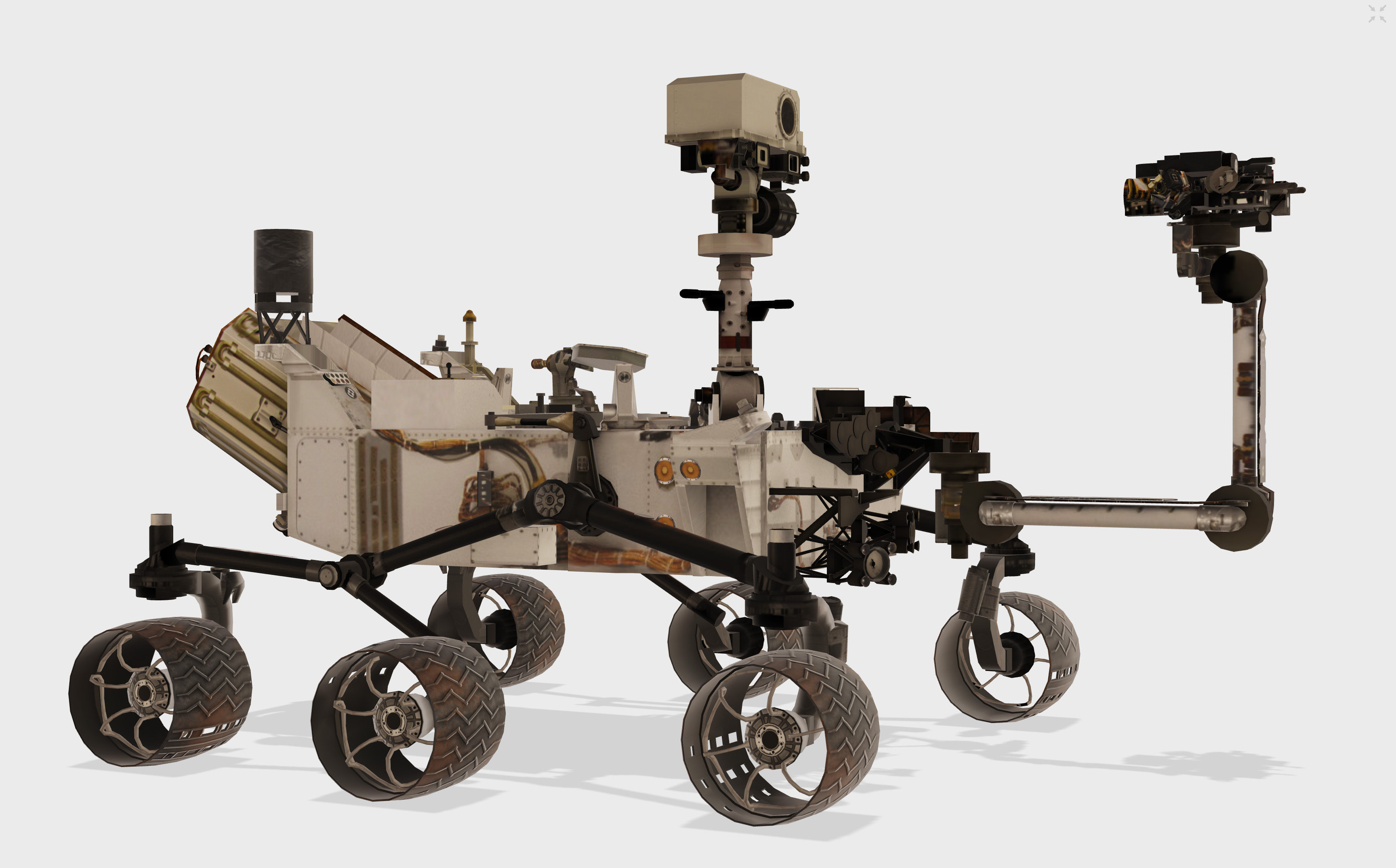
NASA's Mars Science Laboratory, a mobile robot for investigating Mars' past or present ability to sustain microbial life. This picture is an artist's concept portraying what the advanced rover would look like in Martian terrain, from a side aft angle.

With its rover named Curiosity, Mars Science Laboratory mission is part of NASA's Mars Exploration Program, a long-term effort of robotic exploration of the red planet. Curiosity was designed to assess whether Mars ever had an environment able to support small life forms called microbes. In other words, its mission is to determine the planet's "habitability."

Mars Science Laboratory will study Mars' habitability

To find out, the rover will carry the biggest, most advanced suite of instruments for scientific studies ever sent to the martian surface. The rover will analyze samples scooped from the soil and drilled from rocks. The record of the planet's climate and geology is essentially "written in the rocks and soil" -- in their formation, structure, and chemical composition. The rover's onboard laboratory will study rocks, soils, and the local geologic setting in order to detect chemical building blocks of life (e.g., forms of carbon) on Mars and will assess what the martian environment was like in the past.

Mars Science Laboratory relies on innovative technologies

Mars Science Laboratory will rely on new technological innovations, especially for landing. The spacecraft will descend on a parachute and then, during the final seconds prior to landing, lower the upright rover on a tether to the surface, much like a sky crane. Once on the surface, the rover will be able to roll over obstacles up to 75 centimeters (29 inches) high and travel up to 90 meters (295 feet) per hour. On average, the rover is expected to travel about 30 meters (98 feet) per hour, based on power levels, slippage, steepness of the terrain, visibility, and other variables.

The rover will carry a radioisotope power system that generates electricity from the heat of plutonium's radioactive decay. This power source gives the mission an operating lifespan on Mars' surface of a full martian year (687 Earth days) or more, while also providing significantly greater mobility and operational flexibility, enhanced science payload capability, and exploration of a much larger range of latitudes and altitudes than was possible on previous missions to Mars.

Arriving at Mars in 2012, Mars Science Laboratory will serve as an entrée to the next decade of Mars exploration. It represents a huge step in Mars surface science and exploration capability because it will:

  • demonstrate the ability to land a very large, heavy rover to the surface of Mars (which could be used for a future Mars Sample Return mission that would collect rocks and soils and send them back to Earth for laboratory analysis)

  • demonstrate the ability to land more precisely in a 20-kilometer (12.4-mile) landing circle

  • demonstrate long-range mobility on the surface of the red planet (5-20 kilometers or about 3 to 12 miles) for the collection of more diverse samples and studies.

Mars Science Laboratory

Launch:
Nov. 26, 2011

Launch Vehicle:
United Launch Airforce Alliance Atlas V

Expected Arrival: August 2012

Mission Fact Sheet
Mission Fact Sheet (PDF, 768 KB)

What does it take to get a spacecraft from Earth all the way to Mars? There are a few key things to consider, as explained in this 60-second video from NASA's Jet Propulsion Laboratory.
Mars in a Minute: How Do You Get to Mars?
What does it take to get a spacecraft from Earth all the way to Mars? There are a few key things to consider, as explained in this 60-second video from NASA's Jet Propulsion Laboratory.
› Watch Video


USA.gov
PRIVACY     FAQ     SITEMAP     CREDITS     FEEDBACK